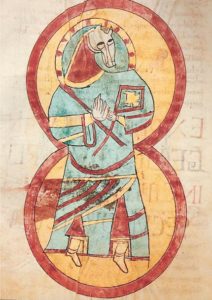
Un Livre d’heures à l’usage de Tréguier (?) de la bibliothèque municipale de Lyon
Texte publié dans : Jean-Luc Deuffic, Notes de bibliologie. Livres d’heures et manuscrits du Moyen Age identifiés, dans Pecia. Le livre et l’écrit, 7, 2009 [Lien].
Images de musiciens (1350-1500)
A paraître:
Martine Clouzot, Images de musiciens (1350-1500) Typologie, figurations et pratiques sociales. Brepols Publishers. 353 p., 150 ills. couleur, 190 x 290 mm, 2008, broché, ISBN: 978-2-503-52345-3, € 125 HT Collection : Épitome musical.
Prix de lancement de € 99 TTC valable jusqu’au 31 mars 2008.
 Les livres enluminés du Moyen Âge résonnent de mélodies instrumentales jouées par des musiciens hauts en couleurs : ménestrels, jongleurs, muses, animaux, grotesques, sirènes, anges, ainsi que le roi David emplissent les peintures des bibles, des psautiers, des livres d’heures, des traités, des chroniques et des romans. Toute une palette visuelle et sonore s’offre à la vue et à l’ouïe des lecteurs, spectateurs et auditeurs de l’époque et d’aujourd’hui. La beauté des images doit tout autant au talent des enlumineurs qu’à la pensée symbolique qui la structure. Quelles sont alors les formes iconographiques des musiciens dans les manuscrits peints ? Quelles conceptions de la musique et des instrumentistes nous donnent-elles à voir et à entendre ? En quoi la mise en image de la musique est-elle une clé de compréhension du monde au Moyen Âge ? La société bourguignonne de la deuxième moitié du XIVe siècle à la fin du XVe siècle sert de cadre à cette réflexion située à la croisée de l’histoire, de la musique, de la culture et de l’art.
Table des matières :
Aux marges de la musique
Entre dérision et sacrilège: animaux, grotesques et squelettes musiciens: L’animal musicien – Une iconographie musicale de la mort – Danses et mélodies macabres Le jongleur, figure et discours: Le jongleur homo ludens – Le jongleur homo viator, un marginal ? – Diabolisation et moralisation des discours
La musique du pouvoir
La musique de la cité: Les instruments de la ville – Les ménestrels au service d’ordre – Du miracle à la confrérie: le métier de musicien
Les ménestrels du prince: Une hiérarchie desinstruments et des musiciens – Le statut des ménestrels à la cour – Le duc et ses trompettistes : service et fidélité
Harmonies princières: La cour en représentation : musique et cérémoniels – Les trompettes aux tournois et à la guerre – Le son et le pouvoir : les entrées solennelles
De la musica à l’harmonie du monde
Au rythme des processions et des mystères: Une société en ordre : la procession religieuse – Une musique théâtralisée: le Mystère de la Passion – Le théâtre du monde ?
Musica : des mathématiques à la science divine: Les « inventeurs » de la musica : Pythagore, Tubal et les allégories de la musique – Les musiciens savants à la cour : entre théorie et pratique – Musique et médecine: une image et un remède à la mélancolie – Musicus et Praefigura Christi : le roi David harpiste
L’harmonie du monde: Les anges de l’Apocalypse et du Jugement dernier – Le cosmos musical: l’harmonie des sphères et la musique des anges – Une hymne à la beauté du monde
Conclusion
Bibliographie – Table des illustrations – Crédits photographique
Brepols Publishers: site web [Lien]
De la chasse aux manuscrits: une douce folie?
 Du 14 février au 6 avril 2008, La galerie-librairie Les Enluminures (Paris, Louvre des Antiquaires) présentera son exposition de printemps sous le titre : De la chasse aux manuscrits : une douce folie? Cette exposition s’intéressera à la notion de « provenance » des manuscrits, groupés autour de quatre thèmes : des lieux, des hommes (et des femmes), des collectionneurs, des possesseurs.
Des lieux et des hommes : il s’agit ici des abbayes, églises et autres fondations, le plus souvent pieuses, qui ont possédé un ou plusieurs manuscrits sur lesquels on retrouve des marques d’appartenance; des hommes ou des femmes copistes qui ont transcrit et signé leur oeuvre. Comment se sont formées les bibliothèques médiévales ? Quelles traces laissèrent les copistes : signatures, dates, colophons … ?
La troisième partie de cette exposition sera consacrée aux collectionneurs et à leurs collections, maintenant dispersées, comme celles de Sir Thomas Phillipps, véritable « vello-maniaque », qui rassembla de son vivant une des plus importantes collections de manuscrits, de Sir Moses Montefiore, grand collectionneur de judaïca, de Giannalisa Feltrinelli, du duc d’Aremberg, de Earl of Ashburnham ou de Sir Thomas Brooke, possesseur de nombreux volumes de la bibliothèque Pillone. Seront présentés également les grands collectionneurs américains Coella Lindsay Rickettes, Cornelius Hauck et Charles Roseman.
La dernière partie montrera comment les possesseurs successifs ont personnalisé leurs manuscrits : ex-libris, armoiries et autres marques héraldiques, reliures, signatures, portraits, annotations (comme dans certaines Heures devenues « livre de raison » d’une famille), etc
La galerie-librairie Les Enluminures présentera ainsi 45 manuscrits, décorés ou non, composés dans diverses langues. L’exposition sera inaugurée par une soirée conférence-débat animée par trois types d’acquéreurs de manuscrits : un bibliothécaire responsable d’un fonds ancien, un collectionneur privé et un marchand.
 From the 14th February to the 6th April 2008 the bookshop and gallery Les Enluminures (Paris, Louvre des Antiquaires) will host its spring exhibition entitled De la chasse aux manuscrits: une douce folie? (\ »Hunting manuscripts: a delicate madness?\ »). The exhibition is centred on the notion of manuscript provenance, and is grouped according to four themes: places, people, collectors, owners. The themes Places and People include abbeys, churches and other institutions, often religious, which had in their possession one of several manuscripts on which can be seen their personal markings, as well as those of the scribes (both male and female) who copied and signed the works. How were medieval libraries made up? What traces were left by the copyists: signatures, dates, colophons…?
The third part of this exhibition will be dedicated to collectors and their collections, now dispersed, such as that of Sir Thomas Philipps, a real vello-maniaque (\ »vellum-lover\ »), who in his lifetime amassed one of the largest known manuscript collections. Other examples are Sir Moses Montefiore who collected legal works, as well as Giannalisa Feltrinelli, the duc d’Aremberg, the Earl of Ashburnham and Sir Thomas Brooke who possessed many volumes in the Pillone library. Also represented in the exhibition are important American collectors such as Coella Lindsay Rickettes, Cornelius Hauck and Charles Roseman.
The last part of the exhibition will show how successive owners personalised their manuscripts: ex-libris, coats of arms and other heraldic markings, bindings, signatures, portraits, annotations (such as in certain Books of Hours which became a family’s \ »book of reason\ »), etc.
The gallery Les Enluminures will thus exhibit 45 manuscripts, some of which are illuminated, in many languages. The exhibition will open with an evening of conference and debate featuring three types of manuscript collectors: a librarian responsible for manuscript collections, a private collector and a seller.
Illustration: Master of Anna Sforza. Prophet with a Scroll [Italy, Lombardy (Milan), c. 1500] (c) Les Enluminures
Galerie Les Enluminures
Le Louvre des Antiquaires
2, place du Palais Royal
75001 Paris
33 1 42 60 15 58
info@lesenluminures.com
http://www.lesenluminures.com
http://www.textmanuscripts.com
Bridwell ms 35
See for description of Bridwell MS 35:
http://www.smu.edu/bridwell/specialcollections/bridwellwesternms/ms35.htm
Christopher De Hamel in his description of The Bible of Wouter Grauwert, in Latin, 1443-45, refers to MS 35 as below:
\ »The mixing of Old and New Testaments is quite unexpected at any period of biblical history, known to us as occurring only, although differently, in the so-called ‘Biblia Irregularis’ of the early thirteenth century [almost certain before 1230], now MS 35 in the Bridwell Library at Southern Methodist University, Dallas.\ »
In his description of the smaller illuminated initials in the Wouter Bible, he states that \ »In addition [to the 13 large historiated initials], there are many large initials which show animals and creatures which are not illustrative of the text as such but are certainly pictorial, such as a jester emerging from a flower and playing two pipes, a wing dragon with a human head, a young woman with the hind legs of a dog …\ » The BI is certainly filled with animals and creatures not illustrative of the text.
Christopher De Hamel looked at the manuscript when he lectured at Bridwell on his last visit and his comment after looking at it for some time, was that he had examined over 3,000 ms., and that he had never seen anything like it, probably not produced in France, evidently written/copied before 1230, and maybe even before 1220.
Several other renowned medieval scholars, including Dr. Larry Ness, are as puzzled about the text as Dr. De Hamel.
I have been worked on the manuscript for the last 5 years and am almost convinced that the BI is of an Alcuin exemplar of the late 10th cent., as many of the variants are from Consensus codicum secundum exemplar Alcuini scriptoriam; Legionessis, Leon, S. Isidoro, codex gothicus. 960 in Hispinia; Toletanus, Madrid, Bibl. Nac, Vitr. 13-1 (Tol. 2-1, s.x. in Hispinia).
Also, the Confessio Esdras, IV Ezra (II Esdras) chapter 8, v. 20-36, is included as a separate text following the end of Nehemiah, which appeared as a separate text for first time in the Codex Legionesis, ca. 960. Which later became a Christian confession of faith! The Gospels follow the Confessio as the last 4 books. The MS in not the result of faulty rebinding as each book follows the previous book on the same folio. The following inscription is of a perplexed 17th century reader: \ »the scribe originally copied them, for reasons yet to be determined, in this strange order.\ » Ownership inscription of the Celestines of Sens, 1681.
And, that the animal/beast images seen in the Eastern textiles hanging in the cathedrals served as the model for the 8 historiated and the 63 floriate initials with animal/beast, beads heads and birds, similar to Gautier Lebaube atelier (i.e., in Branner), smaller initials in red and blue within red and blue with complementary pen work extensions throughout. Illustrations include an Ass playing a harp, an Ass on his hind legs with bells in both front feet, a rabbit playing a harp, only 3 human type figures with weapons (sword, club with shield, and drawn bow), etc. Why else would they be seen in a 12th-13th century bible, with the mingling of the books, void of any Jewish/Christian symbols.
Any suggestions would be appreciated. I can send samples of text and images if interested. I am currently working on a power-point presentation.
Page A. Thomas
Retired, Special Collection
Birdwell Library
Southern Methodist University
PAGES ANNEXES
Auteur du blog : Jean-Luc DEUFFIC

Evangeliaire breton (Boulogne-sur-Mer, BM, ms 8)